The University of Florence (Università degli Studi di Firenze) in Italy has an established trackrecord in ground-breaking research in medical, biomedical and clinical sciences. One particular
area in which it has a strong team and leading reputation is in investigating cancer metabolism.
Dr. Luigi Ippolito, researcher at the University of Florence, specializes in research in this emerging
field that could help us find new ways to detect cancer and treat it. He explains how new tools,
such as PHCbi’s LiCellMo, can support these important studies.

University of Florence
Cancer-associated metabolic reprogramming causes
changes in intracellular and extracellular metabolites,
providing an opportunity to identify and classify cancer,
as
well as direct treatment. Individual tumors exhibit specific
metabolic hallmarks.
Dr. Ippolito is at the forefront of
research in this field and works on several cancer
metabolism projects at the University of Florence’s
laboratory of Professor Paola Chiarugi.
His current research is especially focused on the metabolic
communications occurring in tumor microenvironments.
“My research is mainly focused on prostate cancer
progression and the metabolic changes associated with
prostate cancer,” he remarked.
“We are exploring the
metabolic interaction between stromal cell populations
and prostate cancer cells in primary tumors.
And we
study lactate because it has been found that lactate levels increase along with prostate cancer progression.
Following this it is exploited by prostate cancer cells to
become more aggressive.”
Key metabolites
Lactate is an abundant oncometabolite in cancer
metabolism. In prostate cancer, cancer-associated
fibroblasts (CAF) are major contributors of secreted
lactate, which can be taken up by cancer cells to sustain
mitochondrial metabolism. However, many other factors,
such as how lactate impacts transcriptional regulation in
tumors, have yet to be fully determined.
“Lactate is not only a metabolic regulator of lipid
metabolism in prostate cancer, but it is also an epigenetic
driver because it changes the acetylation of histones (i.e.
gene expression) in the prostate cancer cells, resulting in
the transcriptional support for the metastatic progressionof cancer cells.” said Dr. Ippolito.
“We first
published a paper on lactate in Cancer
Research journal a couple of years ago (PMID:
35135811).
More recently, we have been
studying the metastatic niches and the
metabolites influencing the metastatic
microenvironment,” continued Dr. Ippolito.
“Our
goal is to identify organ-specific metabolites
and their impact on prostate cancer
metastatization. We are also exploring the
measurement of metabolite content in some
tissues, such as lungs and bone from mouse
and human models.
“The field of cancer metabolism has been
revolutionized by new knowledge in the
glycolytic field,” he continued.
“So, measuring glucose and
lactate is vitally important for our research because, for
example, the levels of glycolytic activity can change with
treatment or upon exposure with stromal cells.
And there
is a separate reaction that can be found in the tumor
environment. Glucose and lactate measurements are
important to give us an initial idea.”
Well-equipped facilities
The University of Florence is well-equipped for metabolic
analysis with large facilities that incorporate capabilities
in chromatography, gas/liquid mass spectrometry
instruments, a Seahorse analyser, and other special
instruments (like Oroboros O2k).
Previously,
measurement of glucose and lactate was carried out by
commercial kits initially and then with mass
spectrometry.
“LiCellMo probably could make our
experimental setting more reliable in terms
of lactate analysis particularly”
However, using PHCbi’s new LiCellMo now brings many
benefits, such as provision of a detailed online readout of
the glucose and lactate over several days.
「“It is good to measure in real-time for several days these
two parameters to have an idea about changes that can
occur within the tumor cells. It impacts on the short-term
and long-term analysis,” said Dr. Ippolito. “It might impact
on having an idea of the effectiveness of metabolic or non-metabolic drug targeting in our models and can be
useful to transpose to murine models. For example,
measurement of tumor metabolic labelling in mice can be
done after a few days after establishment of the tumor,
and can be repeated after a long time to compare
changes previously observed in in vitro settings”
“The LiCellMo instrument is quite user friendly. It is very
easy to handle. Particularly in the steps of preparation of
the cell seeding onto the plate,” he added. “The
instrument is independent and straightforward.”
Valuable data
Dr. Ippolito and his team have found the data quality, the
sensitivity, the resolution, and the accuracy of the
LiCellMo good.
“The LiCellMo instrument is quite user
friendly. It is very easy to handle.
Particularly in the steps of preparation of
the cell seeding onto the plate”
“I am confident about the data. The data provided by the
instrument and software are very good, very well
explained in the raw data. And the raw data provided
through the Excel format is useful for all the users. Even
after the normalisation, the data the software provides
are very reliable and helpful in terms of colours and
graphs. I think they are very reliable data,” he said. “The
instrument probably could make our experimental setting
more reliable in terms of lactate analysis particularly. And
the measurement over several days could be implemented in our experimental settings to measure the
mean glycolytic parameters of cellular models.”
A compact research companion
The LiCellMo uses 24-well plates which Dr. Ippolito has
found very useful.
“The 24-well plate format is good for my experimental
settings, because there are a lot of wells that can be used
for a lot of different conditions,” he said. “I like the
dimensions of the instruments. They are very small. The
space that the LiCellMo occupies is very small, so it's not
a problem in our laboratory. We can put the instrument in
our cell culture room.
With the LiCellMo, we do not need a dedicated incubator.”
Dr. Ippolito’s department have recognized the LiCellMo
could be a compact companion in their research.
INFORMATION
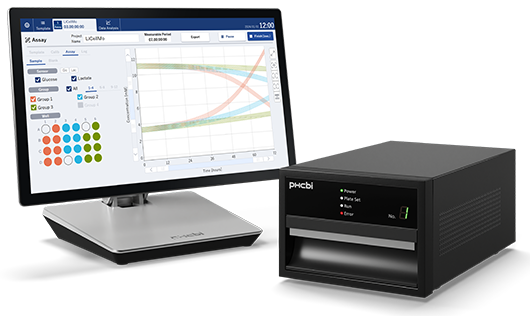
LiCellMo - Live Cell Metabolic Analyzer