The Research Institute for Farm Animal Biology (FBN) in Dummerstorf, Germany is focused on
exploring better livestock management within the context of sustainable farming. The Institute
organizes its research into four main topics: individualising farm animal husbandry, farming
animals in sustainable resource cycles, coping with critical life phases of farm animals, and
promoting diversity in animal farming. Within this, a number of Working Groups explore specific
themes. FBN’s Working Group Cell Biology of Muscle Growth is headed by Dr. Monika Röntgen.
She outlines how new research tools, such as PHCbi’s LiCellMo, offer greater accuracy and timesaving capacity measuring important parameters in myogenesis (muscle development and
growth).
Postnatal myogenesis depends on muscle stem cells
including satellite cells (SC). The number and functional
properties of these stem cells determine muscle
formation, growth, regeneration potential, and
adaptability. And, during critical periods of muscle
development, their functionality can be changed
permanently by a variety of factors.
“Our research aims to contribute to a better
understanding of the processes of muscle development
and plasticity towards improving muscle health, body
composition, and meat quality in farm animals. We are
also looking at alternative and environmentally friendly
ways to produce animal protein as a component of global
food security,” she explained. “Our main research topics
are the molecular and metabolic control of early
postnatal myogenic processes in farm animals,
modulation of SC growth behaviour by dietary
compounds, bioactive substances and components of the
immune system, and generating protein for human
nutrition from animal stem cells.”
Focused from the start
The work group is particularly interested in better
understanding muscle development in the very early
postnatal period. This is a critical period because two
things happen. Firstly, the (adult) stem cell population
develops. And secondly, the muscle tissue, in particular
the myofibers, grow very rapidly.
“So far, not much research on the role of stem cells in
early muscle development of farm animals has been
carried out by others,” said Dr. Röntgen. “We focus on
research in the pig because it is a very important farm
animal, and is also a very interesting model for human
medicine.”
“Specifically, we are trying to find out more about an
important genetic disease that occurs in this early period:
‘splay leg syndrome’, which renders piglets unable to
stand and, therefore, unable to drink. It can result in the
early death of affected piglets,” she continued. “The
pathogenesis of this disease is not really understood. It
also occurs in many other species: humans, dogs and
sheep. Increasing our understanding of the disease
elucidates more about early and prenatal muscle
development – both of which are disturbed in this
disease.”
The Cell Biology of Muscle Growth Group is also very
interested in finding out new ways of reducing the use of
antibiotics through alternatives and concentrate on
studying the role of probiotics in this.
Cultured meat
However, the Group’s biggest project at the moment is to
develop a complete process to make cultured meat using
pig stem cells. This project is funded by the German
Federal Ministry of Education and Research and the FBN
works together with three other partners: two research
institutes and one company.
Scaling up
In Dr. Röntgen’s group, among others, M.Sc. Tessa Wolter
works on this project, which is focused on finding
solutions to produce high quality animal proteins in a cellbased way.
“In general, we are very interested in metabolic processes
and the regulatory role of metabolic and mitochondrial
signals in cell proliferation and differentiation, of which
lactate plays an important role “, said Dr. Röntgen. “To
produce muscle cells for cultured meat, we need to reach
a higher efficiency of myogenesis. On way to do this is by
changing the media composition in a way that can make
the metabolism of the cells more effective.”
The LiCellMo can be used to analyse media
samples taken from your bioreactor for
glucose and lactate to control cell growth
and metabolic activity.
“In our work, we have to perform a lot of tests to optimise
our media with respect to glucose and other
components,” she continued, “The LiCellMo helps us
because we can see resulting positive or negative effects
of such changes directly, in real-time. Normally, you
would have to finish your experiments before you could
start analysing the media samples. And this, of course, is
a very time-consuming process.”
With the LiCellMo, the research team can directly see how
the cells metabolic activity reflected by pH, glucose and
lactate will change and can make fast decisions on the
optimal time for media changes.
“Another point is that we have to scale up,” remarked Dr.
Röntgen. “This is one of the biggest challenges because in
standard cell culture we normally use dishes or flasks
with small volumes of 12 to 20 ml. When you start
working with a bioreactor, the volume is much higher and
you need to find out first which cell density is optimal.
This sounds simple but this is the main point for all the
other steps that will follow. In our case, we switched first
from a 12 ml dish into a smaller bioreactor which has a
whole volume of 200 millilitres, and started to work at a
higher scale level by using a bioreactor which has a
volume of 20 litres. Of course, you cannot quickly transfer
the situation from the dish into this high volume. Thus,
you have to control what happens over time. The LiCellMo
can be used to analyse media samples taken from your
bioreactor for glucose and lactate to control cell growth
and metabolic activity.”
Practical benefits
Practical benefits
“One advantage of the LiCellMo is its small size. It fits very
well into our incubator and doesn’t occupy too much
space. So, there is still enough space to do other
experiments in parallel,” said Ms. Wolter. “The display
showing the data on time was also very helpful.”
“The LiCellMo is simple to use, and most important, it is
very, very sensitive. Therefore, it is very important to have
media blanks for all tested conditions to differentiate
between cell activities and handling effects, e.g., by
opening the incubator door.
“Another advantage of the LiCellMo is that you can do the
experiments in a low volume format which help to save
resources like primary cells or media.” she pointed out.
“In contrast to the 96 well format, the 24 well plate format used with the LiCellMo is not too small. This is important
because in many cell types the ability to proliferate and to
differentiate differs depending upon the size of your dish.
You have to find out the optimal format but 24 well is a
nice format to start with and cells often grow better than
in smaller formats.”
The LiCellMo is simple to use, and most
important, it is very, very sensitive
Dr. Röntgen added that commercially available test kits
have previously used for measuring lactate in particular,
but the LiCellMo brings significant plus points.
“Lactate is very important in muscle, of course.” she said.
“Typically, measuring lactate dehydrogenase activity in muscle tissue or cells is a standard method to get
information on the metabolic situation. Another method is
measuring the extracellular lactate concentration using
test kits which in our hands were not sensitive enough
specifically when working with cells. In addition, for both
methods samples are analysed after finishing the
experiment. Here, I must say, that the lactate analysis
with the LiCellMo works much better because of its
higher sensitivity.”
“It's also an advantage that you can carry out other
experiments in parallel because the LiCellMo uses
normal, commercially available cell culture plates,” Ms.
Wolter said. “And, most important, you can use the cells
for downstream investigations after monitoring them. For
example, you can determine cell numbers, DNA and
protein concentrations to characterise the cell growth or
investigate the expression of genes to understand
regulatory processes. It’s not an end point assay with the
LiCellMo. If you are interested in other tests or treatments
during the measurement, you can pause the LiCellMo at
any moment and then continue measuring later on.”
Future potential
For Dr. Röntgen, direct measurements from larger
bioreactors are likely to be key.
“It is already an advantage that we can analyse media
from our bioreactors with equipment such as the
LiCellMo,” she said. “We know that later on…really in the
future…we will have much larger bioreactors, and then, it
would be great to have a direct possibility to sample and
control the media in a bioreactor over time. So that we
can directly take a sample, analyse it, and get relevant
information.”
Find out more about the Research Institute for Farm Animal Biology (FBN)
https://www.fbn-dummerstorf.de/en/
Learn more about Dr. Monika Röntgen’s group:
https://www.fbn-dummerstorf.de/en/research/working-groups/cell-biology-of-muscle-growth/
INFORMATION
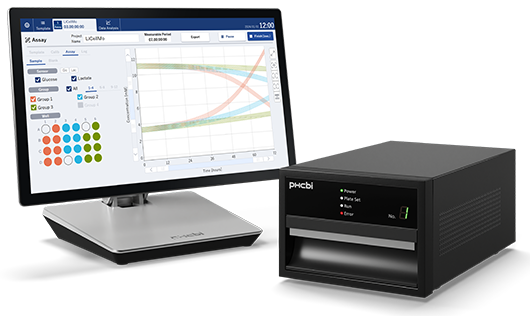
LiCellMo - Live Cell Metabolic Analyzer